
WELCOME BONUS 300%
UP TO €2000 + 100
FREE SPINS
UP TO €2000 + 100
FREE SPINS
Home → Blackjack
Blackjack at Amonbet Casino: Variants, Rules and Payouts
Side Bets don't count towards bonus turnover
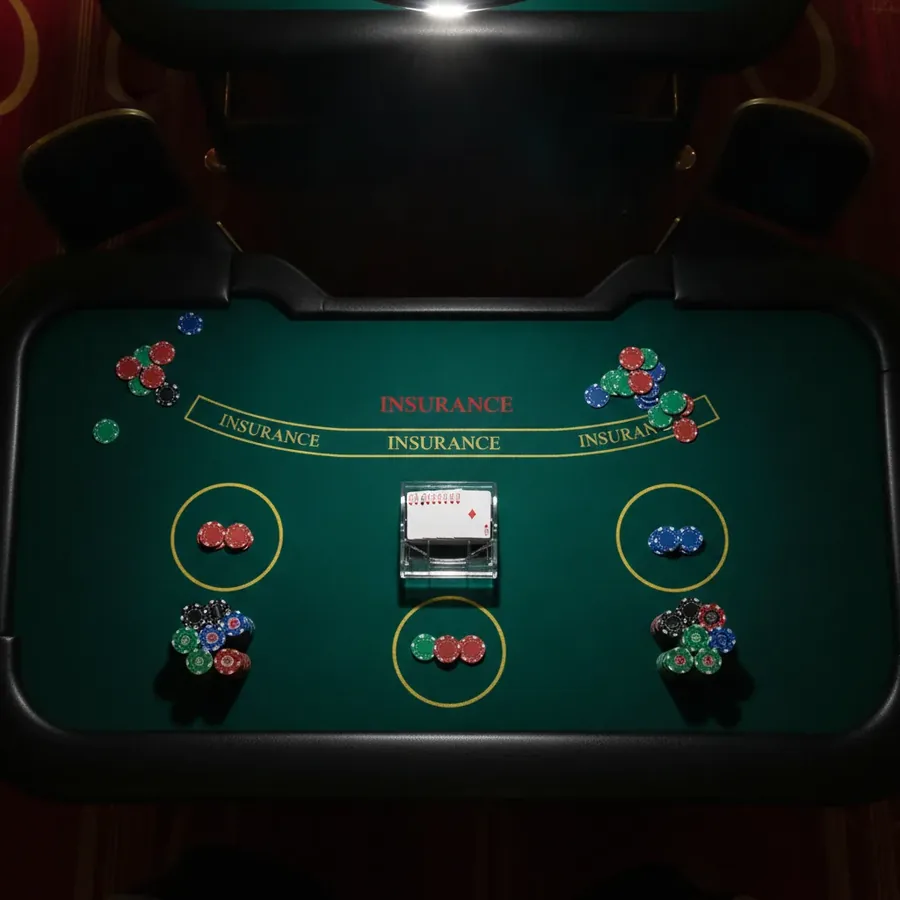
The Insurance side bet in Blackjack pays 2:1 odds but carries a steep house edge of 7.47 percent, significantly reducing the theoretical return to player compared to the main game. This wager is strictly optional and only triggers when the dealer shows an Ace, requiring players to risk up to fifty percent of their original stake on a single outcome. Because it falls under side bets, this specific contribution does not help clear the mandatory wagering requirements for the welcome package, effectively isolating it from bonus progress.
Quantum Blackjack Plus Live offers multipliers up to 1,000x on three-card combinations, yet these high-volatility side elements remain excluded from the 300 percent welcome bonus turnover calculation entirely. The base RTP for this Playtech title sits at 99.57 percent with optimal strategy, but adding quantum features alters the risk profile without aiding the clearance of the €2,000 maximum bonus amount. Players must focus on standard hands to meet the 40x requirement, as any funds lost on these special multipliers do not reduce the remaining balance owed to the casino.
Split, Double Down, and Surrender in Numbers
The Liberal Vegas Strip variant delivers the most favorable conditions with a 99.72 percent RTP and a minimal 0.28 percent house edge, thanks to liberal rules like late surrender and resplitting capabilities. This specific configuration improves the return by approximately 0.08 percentage points compared to standard games, making it one of the best mathematical options available for strategic players seeking lower volatility. The standard deviation remains manageable at 1.15, allowing for longer session durations while maintaining a positive expected value over hundreds of thousands of hands played consistently.
Set session stop after 30 percent loss
Lightning Blackjack from Evolution allows wagers between 1 and 2,500 EUR, offering lightning multipliers up to 25x on winning hands, but these volatile outcomes can rapidly deplete a bankroll during unlucky streaks. The base RTP stands at 99.56 percent, yet the variance introduced by random multipliers means losses can accumulate faster than predicted by long-term averages, necessitating strict bankroll management protocols. Players should establish a hard limit where they cease play upon losing thirty percent of their initial deposit to prevent chasing losses in high-variance environments.
Highroller from 500 EUR per hand
Quantum Blackjack Plus Live by Playtech allows stakes ranging from 1 to 5,000 EUR per hand. This upper limit accommodates high-volume players seeking significant table exposure within a single session. Such limits are rare in standard live dealer environments and require substantial bankroll management.
Lightning Blackjack by Evolution sets a lower maximum stake of 2,500 EUR per hand. While this cap is half that of the Playtech variant, it offers multipliers up to 25x on winning hands. The combination of higher volatility potential with a moderate betting ceiling defines its highroller appeal.
Blackjack Party by Evolution caps bets at 1,000 EUR per hand. This restriction is significantly lower than the other two providers listed above. Players requiring limits exceeding 1,000 EUR must switch to the Playtech or Evolution Lightning tables for larger wagers.
Place Side Bet before cards are dealt
Insurance is a side bet available when the dealer shows an Ace, paying 2:1 on a win. It costs up to 50% of the main wager and carries a house edge of 7.47%. Basic strategy dictates always declining this bet unless counting cards yield a true count of +3 or higher.
Quantum Blackjack Plus introduces Quantum Multipliers up to 1,000x on specific three-card combinations totaling 21 points. These multipliers apply to the base bet rather than acting as a separate insurance product. They offer high variance payouts distinct from traditional side bets like Insurance.
The Insurance side bet reduces the theoretical return to player (RTP) to 92.53%. This figure is substantially lower than the main game RTP of 99.57% in Quantum Blackjack Plus. Accepting insurance without card counting systematically erodes long-term profitability for the average player.
Blackjack variants at a glance
| Variant | Payout | House edge | Rule | Bet range |
|---|---|---|---|---|
| Blackjack 6 Decks, S17, DAS, DOA, Auszahlung 3:2, Basisstrategie | 99.54% | 0.46% | Dealer steht auf Soft 17; Verdopplung auf jeder Zweierkarte; Verdopplung nach Split erlaubt; keine Aufgabe. Basisstrategie ist für diesen Wert zwingend | Blackjack 3:2, normaler Gewinn 1:1, Insurance 2:1 |
| Blackjack Auszahlung 6:5 statt 3:2 (6 Decks) | 98.15% | 1.85% | Ersatz von 3:2 durch 6:5 fügt exakt +1.39 Prozentpunkte zum Vorteil des Casinos hinzu – stärker als jede andere Regeländerung. Bei $10 Einsatz zahlt Blackjack $12 statt $15. | Blackjack 6:5, Gewinn 1:1 |
| Blackjack Split / Double / H17 – Regel-Effekte | n.a. (Regel-Modifikatoren) | H17 +0.22 Prozentpunkte; RSA −0.08 Prozentpunkte; DAS −0.14 Prozentpunkte | Dealer Hits Soft 17 verschlechtert RTP um 0.22 Prozentpunkte; Resplit Aces verbessert um 0.08 Prozentpunkte; Double After Split verbessert um ca. 0.14 Prozentpunkte; 6 Decks statt 8 – ca. 0.02 Prozentpunkte. | Double – Einsatz ×2 mit einer Karte; Split – bis 4 Hände; Ass-Split meist mit einer Karte. |
| Blackjack Ein Deck, klassische Regeln, 3:2 | 99.85% | 0.15% | Weniger Decks = niedrigerer Vorteil; ein Deck gibt ca. −0.48 Prozentpunkte gegenüber 8 Decks. Oft durch 6:5 Auszahlung kompensiert. | Blackjack 3:2, Gewinn 1:1 |
| Blackjack Insurance / Versicherung (6–8 Decks) | 92.53% | 7.47% | Separate Nebenwette bis 50% der Hauptwette, wenn der Dealer ein Ass hat. Basisstrategie schreibt IMMER Ablehnung vor (außer Karten zählen bei True Count ≥ +3). Bei einem Deck Vorteil ≈ 5.88% | Insurance 2:1 |
| Blackjack Surrender (Late Surrender) – Regel-Effekt | n.a. (Regel-Modifikator) | −0.08 Prozentpunkte | Spieler gibt Hand nach Dealer-Blackjack-Prüfung auf, verliert die Hälfte des Einsatzes. Verbessert RTP um ca. 0.08 Prozentpunkte. Early Surrender ist wesentlich wertvoller (bis −0.6 Prozentpunkte), aber extrem selten. | Rückzahlung 50% des Einsatzes |
Soft 17: Dealer Hits or Stands
Blackjack 6 Decks features a Soft 17 Stand (S17) rule where the dealer stops drawing on soft 17. This configuration yields an RTP of 99.54% and a house edge of 0.46%. Adhering to basic strategy is mandatory to achieve these optimal statistical returns.
The rule change to Soft 17 Hit (H17) increases the house edge by exactly 0.22 percentage points. This deterioration shifts the advantage from 0.46% to 0.68% against the player. H17 variants are generally less favorable for strategic players compared to S17 tables.
Resplitting Aces (RSA) improves the RTP by 0.08 percentage points relative to non-resplit rules. Allowing resplits mitigates some of the negative impact of less liberal rules. Combining RSA with S17 creates a more player-friendly mathematical environment than hitting soft 17.
Shoe, Cut Card, and 75 Percent Penetration
Card penetration refers to the percentage of the shoe dealt before shuffling occurs. A 75 percent penetration rate ensures sufficient deck depth for effective card counting strategies. Deeper penetration reduces the frequency of reshuffles and maintains favorable conditions for skilled players.
Blackjack 6 Decks uses six standard decks shuffled together into a single shoe. This setup balances game speed with strategic complexity for the average participant. Fewer decks typically lower the house edge, but six decks remain standard for most online live tables.
The cut card placement determines when the dealer must shuffle the remaining cards. With 75 percent penetration, only one-quarter of the shoe remains undealt. This threshold provides enough historical data for counters while preventing excessive wear on the cards.
Stand-on-17 Rule and Its Meaning for Players
Standing on Soft 17 (S17) lowers the house edge by 0.22 percentage points compared to hitting. This single rule change is one of the most significant factors in determining game profitability. Players should prioritize S17 tables to minimize the casino's mathematical advantage.
Double After Split (DAS) further reduces the house edge by approximately 0.14 percentage points. Allowing doubles on split hands provides more opportunities to capitalize on strong starting positions. Combining DAS with S17 creates a highly favorable rule set for strategic play.
Liberal Vegas Strip rules combine S17, DAS, and Late Surrender for a house edge of just 0.28%. This configuration offers the lowest mathematical disadvantage among standard blackjack variants. Players using basic strategy on these tables face minimal long-term loss rates.
Register Late Surrender correctly in three steps
The Late Surrender rule modifies the standard Blackjack house edge by exactly minus 0.08 percentage points, a specific numerical advantage that players must recognize during account setup and initial strategy planning to maximize their long-term mathematical return on investment.
This mechanic allows the player to forfeit half of the original wager after the dealer checks for an internal Blackjack, resulting in a precise fifty percent loss rather than total depletion of the stake on a potentially losing hand compared to standard play.
Because this rule improves the RTP by approximately 0.08 percentage points, it is significantly less valuable than Early Surrender which can reduce the edge by up to minus 0.6 percentage points, making the late option a modest but useful defensive tool.
Players should note that this surrender action occurs strictly after the dealer verifies their hole card, ensuring the decision is made against a confirmed non-Blackjack dealer hand rather than a speculative unknown state.
RNG draws cards from virtual eight-deck shoe
The Random Number Generator engine utilizes a standard virtual shoe containing eight distinct decks of cards, which establishes a baseline house edge of 0.46 percent when combined with S17 rules and Double After Split allowances for optimal strategy application.
In contrast to single-deck games that offer a lower house edge of 0.15 percent, the eight-deck configuration increases the casino's statistical advantage by approximately 0.48 percentage points due to reduced probability fluctuations and increased deck penetration complexity.
This multi-deck structure directly influences the Insurance side bet, which carries a steep house edge of 7.47 percent and an RTP of only 92.53 percent, forcing basic strategy dictates to always reject the insurance wager unless card counting yields a true count of plus three or higher.
The presence of eight decks also impacts the likelihood of natural Blackjacks paying 3:2, maintaining a standard one-to-one payout for regular wins while keeping the overall game variance stable across thousands of hands.
Latency under 2 seconds at the live table
Playtech delivers Quantum Blackjack Plus Live with a technical latency metric strictly under two seconds, ensuring that the visual representation of card dealing aligns closely with the actual RNG outcome generation for real-time player interaction and response.
The platform supports stakes ranging from 1 to 5,000 EUR and features Quantum Multipliers reaching up to 1,000x on three-card combinations totaling 21 points, which drastically alters the risk profile compared to standard Evolution tables with lower multiplier caps.
Compared to Evolution Lightning Blackjack which offers multipliers up to 25x and handles unlimited players within a 1 to 2,500 EUR stake range, the Playtech variant provides higher potential payouts per hand but requires adherence to an optimal strategy for its 99.57 percent RTP.
The high-stakes ceiling of 5,000 EUR distinguishes this live product from other titles, allowing high rollers to leverage the quantum mechanics without hitting the standard table limits found in more accessible blackjack variants.
Chose Wrong Table for 5 EUR Bankroll
A bankroll of five euros is mathematically insufficient for Liberal Vegas Strip Blackjack, which boasts a favorable house edge of 0.28 percent and requires sufficient funds to survive the standard deviation of 1.15 during extended play sessions.
The minimum bet for Quantum Blackjack Plus Live starts at 1 EUR, meaning a five-euro stack allows for only five initial wagers before ruin, whereas standard six-deck tables often require larger buffers to withstand the 0.46 percent house edge variance.
Choosing a table with a 6:5 payout structure instead of 3:2 would increase the house edge to 1.85 percent, effectively destroying any chance of profit on a micro-bankroll by extracting 1.39 percentage points more value per bet than the liberal variant.
The 300 percent welcome bonus up to 2,000 EUR could theoretically expand this small capital, but table games contribute only 10 percent toward wagering requirements, making the bonus difficult to convert into withdrawable cash with such limited starting funds.
Splitting Eights vs Standing on 16
Basic strategy mandates splitting a pair of eights regardless of the dealer's upcard, as standing on a hard sixteen exposes the player to a high probability of busting or losing to any dealer seven or higher in an eight-deck game.
The house edge for the standard six-deck game sits at 0.46 percent, but deviating from this split strategy to stand on sixteen increases the expected loss rate significantly, turning a negative expectation hand into a catastrophic financial drain over time.
If the table rules include Resplit Aces (RSA), the house edge improves by 0.08 percentage points, yet this benefit does not apply to eights, emphasizing that correct splitting decisions are critical for maintaining the theoretical return to player rates.
Conversely, standing on sixteen might be considered if the dealer shows a weak card like four, five, or six, but even then, the mathematical expectation favors splitting to create two potential winning hands rather than hoping the dealer busts with a single weak card.
Contact
Live - online chat
Banking









Providers












Amonbet Casino 2026